As we complete First Close, we wanted to share an update on how EG Capital’s blended finance structure is aligned with globally recognised frameworks and evidence-based mobilisation outcomes.
1. Alignment with British International Investment (BII) & BCG Blended Finance Typology
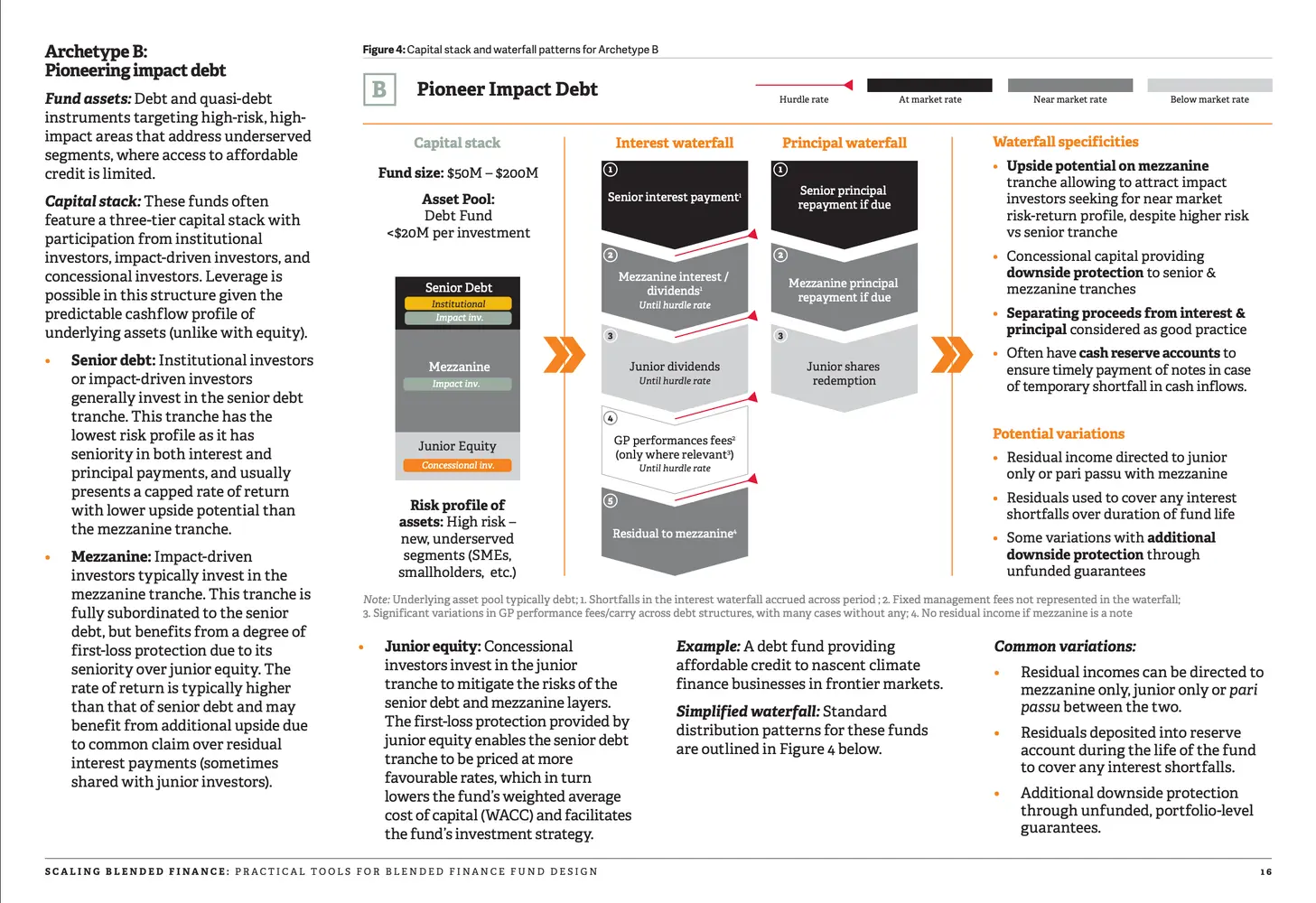
The April 2025 BII–BCG guidance introduces practical structuring tools to support effective blended finance fund design. The typology explicitly recognises “Pioneering Impact Debt Funds” (Typology B) as the appropriate category for funds operating in frontier markets and higher-risk geographies, precisely the context in which EG Capital operates. These funds are expected to incorporate meaningful de-risking to enable institutional participation. Read the report (here).
EG Capital’s structure is fully aligned with this typology, which provides a rigorous framework to match risk environments with the appropriate level and instrument of catalytic capital. The framework has been applied extensively across BII’s blended finance portfolio and has become a reference point for leading development finance and catalytic investors globally.
2. Why Our Structure Qualifies as “Pioneering”
The EG-EEF Fund invests predominantly in LDC and lower-income African markets, across essential climate adaptation sectors in food security, health, and education, using private debt instruments for SMEs. This combination of geography, sector exposure, and instrument class squarely places EG Capital within Typology B “Pioneering” strategies, where catalytic capital is structurally necessary to de-risk market-building vehicles and unlock institutional private capital participation.
3. Evidence That Capital Protection Unlocks Private Mobilisation at Scale
Independent analyses, including work supported by Sida and Convergence, consistently demonstrate that guarantee instruments and structured protection layers are among the most proven and cost-efficient ways to mobilise private capital into development markets. Capital protection of up to c.30% has historically enabled significant private capital mobilisation, often achieving ratios exceeding 2:1 private capital relative to catalytic capital when applied effectively.
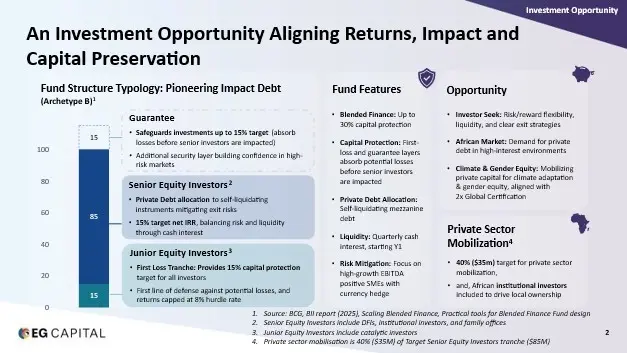
As of 2023, Sida guarantees totalling SEK 15.7 billion mobilised SEK 35.1 billion, delivering more than a 2:1 mobilisation ratio across agriculture, energy, health, and education. This confirms that a 30% risk protection envelope is fully consistent with historic evidence of what is required to mobilise institutional investors at scale into emerging and LDC markets, particularly in SME, health and climate-resilience finance. This evidence base reinforces the rationale for the architecture of EG Capital’s target structure with a guarantee, 50/50 risk sharing, alongside junior equity investors to mobilise $35 million private sector capital.
3. EG Capital’s Structure: Designed for Scale & Integrity
EG Capital’s blended finance design incorporates:
This structure is not experimental. It is anchored in proven frameworks, alignment tools, and mobilisation precedent, designed precisely to enable responsible private sector participation in markets that would otherwise remain under-served.
Our Objective Remains Simple
We aim to:
We look forward to continuing to work collaboratively with our partners and stakeholders to deliver on this ambition and to demonstrate leadership in the evolution of high-integrity blended finance across Africa.